
Since the start of 2015, Gizmag has racked up plenty of sky miles chasing stories about the latest cars and in-car technology at the world's major motor shows and beyond. From American heroes at the LA and Detroit shows to the latest from German powerhouses in Geneva and Frankfurt, we've seen all manner of concept cars. Some were brilliant, while some would've been better if they'd stayed on the drawing board.
As usual, some of the best concepts of the year were high-end sports cars that point to the future of performance driving with clever power trains, slick aerodynamics and dramatic styling. Here are our picks for the best of 2015.

Aston Martin might be best known for creating drop-dead gorgeous sports coupes, or even for its work with James Bond's Q-Branch, but the concept that has made it into our list this year is actually an SUV. The DBX made a surprise appearance at the Geneva Motor Show. According to Aston CEO Dr. Andy Palmer, "it envisages a world, perhaps a world not too far away, when luxury GT travel is not only stylish and luxurious but also more practical, more family-friendly and more environmentally responsible."

Yamaha may be a brand known for its motorbikes and musical instruments, but in 2015 it gave us something special on four wheels.


As usual, some of the best concepts of the year were high-end sports cars that point to the future of performance driving with clever power trains, slick aerodynamics and dramatic styling. Here are our picks for the best of 2015.
10. Aston Martin DBX
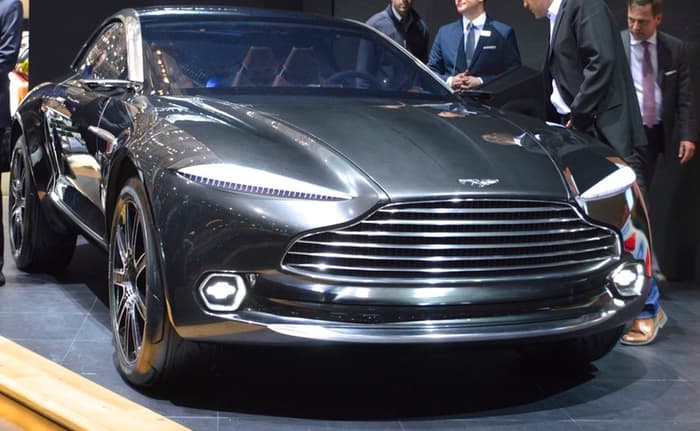
Aston Martin might be best known for creating drop-dead gorgeous sports coupes, or even for its work with James Bond's Q-Branch, but the concept that has made it into our list this year is actually an SUV. The DBX made a surprise appearance at the Geneva Motor Show. According to Aston CEO Dr. Andy Palmer, "it envisages a world, perhaps a world not too far away, when luxury GT travel is not only stylish and luxurious but also more practical, more family-friendly and more environmentally responsible."
Beyond the CEO's slightly ambitious wish list, Aston Martin's engineers are very clear the DBX should be packing a high-tech drivetrain. Power will come from motors in all four wheels, which allows the car to operate in all-wheel drive and frees up space under the hood for storage – important when bootspace is heavily impacted by that sloping roofline. In Aston's vision for the DBX, the motors draw power from lithium-sulfur cells that replenish through an F1-style kinetic energy recovery system (KERS).
9. Yamaha Sports Ride Concept

Yamaha may be a brand known for its motorbikes and musical instruments, but in 2015 it gave us something special on four wheels.
Built around an iStream carbon fiber monocoque designed by Gordon Murray, the Yamaha Sports Ride Concept features a chassis made up of two carbon skins sandwiched around honeycomb core, a method designed to cut the cost and time currently involved in creating carbon fiber for cars. Because of that lightweight carbon core, the MX-5-sized Sports Ride Concept weighs just 750 kg (1654 lb).
There's no word on what might be powering the car, or if it will ever reach production, but the thought of a carbon-tubbed car powered by the motor from the bonkers YZF-R1 is an enticing one.
8. Toyota S-FR

While it may not be pretty to look at, the S-FR is on our list because of what it stands for in the world of sports car motoring. Launched at the Tokyo Motor Show, the tiny Toyota has been designed as a small, rear-drive sports car to slot in underneath the GT86.
Exactly what could slot in under the bulbous hood has not been disclosed, but Toyota was at pains to explain the car has been designed with sharp, responsive handling in mind. The engine is set back in a front-mid mounted configuration for better weight distribution, and there's independent suspension at each corner to help keen drivers keep control on the road or track.
7. Bugatti Vision Gran Turismo

Gran Turismo has spawned some of the most exciting concept cars of the past few years, but none are more exciting than the Bugatti Vision Gran Turismo. That's because this Bugatti isn't just a flight of digital fancy – elements of its design preview the Chiron that will debut in Geneva.
Whereas a lot of the cars conceived for Gran Turismo bear no resemblance to road cars, Bugatti has made a real effort to make sure every element of the design serves some practical purpose. For example the NACA duct on the roof has been designed to channel air to the engine without creating turbulence, and the central fin on the roof of the car contributes to dynamic stability.
Thanks to Bugatti's latest simulation models for dynamics and aerodynamics, we even know that the car should top 400 km/h (250 mph) in four separate areas of Le Mans.
6. McLaren MP4-X

Since swapping to Honda power at the start of this season, McLaren's fortunes in Formula One have taken a steep downturn. It's no surprise, then, the brand has decided to take a look beyond the current situation and do some blue-sky thinking about the future of motorsports.
The MP4-X is what happened when McLaren's engineers pondered the future of fuels, lubricants and power – including electrical power. This approach means the MP4-X's design integrates batteries into the crash structures of the car, and the body includes solar cells that provide extra charge, augmenting the energy recovered by KERS systems.
There's a lot more to the body than just solar panels. The most noticeable aspect of the whole design is the canopy, an idea discussed in the wake Jules Bianchi's death. For a full rundown of what the MP4-X can do, check out Aaron Turpen's in-depth look at the car.
5. Bentley EXP 10 Speed 6

The EXP 10 was one of the biggest surprises dropped on the world's motoring press this year. According to Bentley, the EXP 10 Speed 6 is designed to be the ideal "British interpretation of a high performance two seater using modern automotive design, highly skilled handcrafting, the finest materials and advanced performance technology."
While details about what's lurking beneath the car's British Racing Green exterior are scarce, Bentley has hinted that the EXP's powertrain will attempt to move the game on by incorporating hybrid power instead of simply taking the W12 or V8 from the Continental GT and plonking it under the hood.
The EXP also moves away from the current Bentley trends inside, eschewing pipe-and-slippers styling for a sporty design with a steeply rising centre console and digital gauges in front of the driver.
4. Mercedes Concept IAA

Okay, so the Concept Intelligent Aerodynamic Automobile isn't a sports car in the traditional sense of the word. There's no fire-breathing engine under the hood, and it's not connected to the AMG engineers in Affalterbach.
What has pushed the Concept IAA up to number four on our list is the clever aerodynamics tech that kicks in at 80 km/h (50 mph). Eight segments built into the rear of the car extend the tail section by up to 390 mm (15 in), and flaps built into the front bumper protrude by 25 mm forward and 20 mm towards the rear of the car to improve airflow around the front.
By moving these elements, in tandem with the moving elements on the wheels, the car's drag coefficient drops from 0.25 to a super-slinky 0.19, helping to eke out a few extra miles of all-electric power.
3. Mazda RX-Vision

Launched at the Tokyo Motor Show, the Mazda RX-Vision is the result of the Japanese company's designers being let loose to explore its KODO design language in a front engine, rear-drive rotary coupe.
Just like any good Mazda sports car, there's a rotary hiding under that shapely hood. Although we don't know anything beyond the fact its called Skyactiv-R, the RX-Vision comes from a long line of legendary sports cars, including the RX-7 and the 787B which, in 1991, became the only Japanese car to win the 24 Hours of Le Mans.
Unfortunately, heavy fuel and oil consumption killed the rotary over three years ago. But by badging this concept Skyactiv, Mazda has indicated a willingness to find an efficient solution to making the rotary work in the real world. Here's hoping it gets to production.
2. Porsche Mission E

Having been overawed by the Tesla Model S' incredible acceleration, Gizmag is well and truly convinced there's a future for all-electric supercars. So you can imagine our excitement when Porsche dropped its battery powered Mission E in Frankfurt.
Sitting beneath the car's curvy bodywork are two permanent magnet synchronous motors, which combine for a total output of 447 kW (600 hp), enough to silently transport it to 100 km/h (62 mph) in just 3.5 seconds, and on to 200 km/h (124 mph) in under 12 seconds.
What's more, Porsche has committed to building the car before 2020, with a 500+ km (311+ mi) range and an 800-volt charging system that can boost the lithium-ion batteries to 80 percent in just 15 minutes. Look out Tesla!
1. Honda Project 2&4

The incredible Honda Project 2&4 dropped at the Frankfurt Motor Show, where it tantalized us with a motorcycle powered alternative to the Ariel Atom and BAC Mono. Power comes from the RC213V motorbike's 999cc V4 engine, which is mated to a six-speed dual clutch gearbox for lightning quick changes.
As you'd expect of a motorbike engine, the 2&4's motor does its best work at high revs. Although Honda says the it has been tuned for use on public roads, the engine still produces its peak 158 kW (212 hp) at a screaming 13,000 rpm. The car's maximum 118 Nm of torque is on tap from 10,500 rpm, making it the perfect antidote to today's focus on low-rev torque and turbochargers. If you want to get somewhere quickly, that engine demands you keep your foot in all the way to its 14,000 rpm redline.
In keeping with the car's pure, motorcycle inspired design there's hardly any bodywork to get in the way. In fact, there's very little in the way of an interior, with the driver sitting just centimetres off the ground on a lightweight seat. Instead of a traditional instrument binnacle, there's just a small display attached to the steering column.
Interestingly, the car's seat can be moved from side to side: it was launched in left-hand drive at the Frankfurt Motor Show, but the seat was moved to the right hand side for the Tokyo Show later in the year.
We've got our fingers and toes crossed in the hope Honda will put Project 2&4 into production.
Honorable Mention: Ford GT

Given that Ford has made it abundantly clear that the GT is destined for production, it's not strictly a concept car – but it looks so radically good that we feel it deserves an honorable mention here.
Packing a twin-turbo EcoBoost V6 under its clear engine cover, Ford is promising the GT will have "one of the best power-to-weight ratios of any production car." It will also take advantage of active aerodynamics thanks to a rear spoiler that adjusts its height and pitch angle depending on speed, driver inputs and road conditions.
To keep weight down, Ford engineers have taken a leaf out of McLaren's book and given the car a full carbon passenger cell. The front and rear subframes are made of aluminum, while carbon has been used for certain structural body panels as another weight saving measure.
And that's it! What gets your vote for the best concept car of 2015? Let us know in the comments below.


